At a glance
- Where
- Central Park West at 79th Street
- Hours
- Daily 10am to 5:30pm; longer on some holiday dates
- Best for
- Dinosaur fans, families and first-time visitors
- Time needed
- About 4 hours
- Nearest subway
- B (weekdays) or C to 81 St; 1 to 79 St
- Under 3
- Free
The American Museum of Natural History, on Central Park West, is where New York keeps its dinosaurs: about 100 of them on the fourth floor, from Tyrannosaurus rex to a 122-foot titanosaur. Add a 94-foot blue whale, live butterflies and the Hayden Planetarium, and you’ll want about four hours.
Here’s what to see, which ticket to choose, how pay-what-you-wish works for New York State residents, when to go and how to get there, all checked on the museum’s website on November 24, 2026.
Before you go: holiday season 2026
- Closed two days. The museum is closed on Thanksgiving, Thursday, November 26, and on Christmas Day, Friday, December 25, 2026.
- Parade eve. On Wednesday, November 25, streets around the museum close for the Macy’s Thanksgiving Day Parade balloon inflation.
- Longer hours. 9am to 5:30pm on November 27 and 29; 9am to 8pm on November 28 and from December 26 to 30; 10am to 8pm on Saturdays December 5 and 19 and every Saturday in January 2027. Before 10am or after 5pm, use the Central Park West or 81st Street entrance.
- New on view. Monumental, works by Northwest Coast artist James Hart, opened on November 20, and the Origami Holiday Tree, themed on animal athletes, is up from November 23. Both are included with admission.
The dinosaur halls on the fourth floor
Take the elevator to the fourth floor for the fossil halls. They hold about 100 dinosaur specimens, and the museum says 85 percent of the specimens there are real fossils, not casts. The Titanosaur, a life-size cast of the 122-foot Patagotitan mayorum discovered in 2014, greets you in the Wallach Orientation Center, its neck and head stretching out toward the elevators.
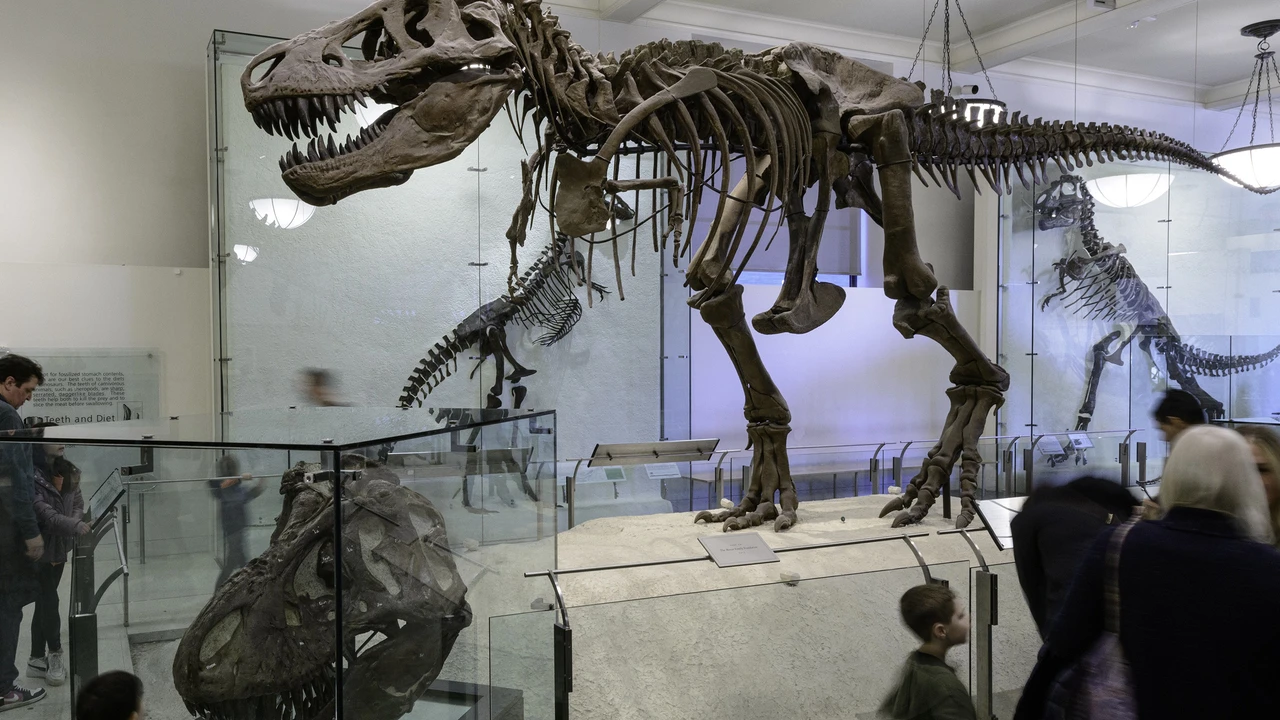
- Hall of Saurischian Dinosaurs: Tyrannosaurus rex and Apatosaurus. A museum fossil hunter found the first T. rex skeleton in Montana in 1902 and a nearly complete one there in 1908. The mount, about 45 percent real fossil, first stood upright; the museum later decided a stalking pose was more accurate, and that’s how you see it now, head low and tail out.
- Hall of Ornithischian Dinosaurs: Triceratops, Stegosaurus and a dinosaur “mummy”.
- Apex: the largest Stegosaurus fossil ever found and one of the most complete, 27 feet long and 11.5 feet tall, at the entrance to the fossil halls from the Gilder Center. It’s about 150 million years old, was found in 2022 near Dinosaur, Colorado, and keeps more than 254 of its roughly 320 bones. It’s included with any ticket.
- Impact: The End of the Age of Dinosaurs (ticketed), in the LeFrak Family Gallery since November 2025: the asteroid strike of 66 million years ago, re-created at the moment it hit what is now the Yucatan Peninsula, with life-size models including a 27-foot mosasaur and a 30-foot plesiosaur, a real Triceratops toe fossil you can touch and a six-minute panoramic film.
- Three more halls on the same floor cover vertebrate origins and early and later mammals: the Halls of Vertebrate Origins, Primitive Mammals and Advanced Mammals.
The blue whale and the first floor
The blue whale hangs from the ceiling of the Milstein Hall of Ocean Life on the first floor. It’s a 94-foot fiberglass model of a female, weighs 21,000 pounds and has been on display since 1969. When it was restored in 2003, artists made it more accurate: they flattened the eyes, redesigned the blowholes, tapered the tail, repainted it with about 25 gallons of blue paint and gave it a belly button, about four-fifths of the way along its body. See if you can spot it.
Also on the first floor:
- Mignone Halls of Gems and Minerals: For the Win: Objects of Sports Excellence is here until January 3, 2027, with more than 70 objects from over 15 sports, among them one of Jesse Owens’s 1936 Olympic gold medals, Kevin Durant’s 2024 Olympic gold medal and the NBA’s Larry O’Brien Trophy.
- Northwest Coast Hall: Monumental, 12 works by James Hart, who carves wood and makes jewelry and bronzes, including 3 WatchMen, a 7-foot pole. They’re shown with a Shark Bracelet from about 1890 by his great-great-grandfather, Charles Edenshaw.
- Hall of North American Forests: the giant sequoia, a stop on the museum’s highlights tour.
- Futter Gallery: the Origami Holiday Tree, from November 23.
On the second floor are the African elephants, and on the third a cast of a Rapa Nui moai and a Galápagos giant tortoise.
The Gilder Center: insects, butterflies and Invisible Worlds
The Richard Gilder Center for Science, Education, and Innovation opened on May 4, 2023, with its own entrance on Columbus Avenue at 79th Street. Its atrium spans four levels. Inside the Gilder Center:
- The Solomon Family Insectarium (first floor, included): live insects and a large leafcutter ant display.
- The Davis Family Butterfly Vivarium (second floor, ticketed): open all year, with up to 80 species of butterflies on view. It’s kept at 80°F with high humidity, so wear a layer you can take off.
- Invisible Worlds (third floor, ticketed): a 12-minute immersive show about the networks of life, including the parts too small, too fast or too slow for the eye. At key moments the projections react to how you move.
- The Gerstner Collections Core (included): displays from the museum’s collections over three levels.
The Hayden Planetarium Space Show
The Hayden Planetarium’s Space Theater is in the Rose Center for Earth and Space, on the museum’s 81st Street side. The current show, Encounters in the Milky Way, narrated by Pedro Pascal, opened on June 9, 2025, and runs 24 minutes. It follows the Sun on its path around our galaxy, at about 500,000 miles per hour, one loop every 230 million years or so. On the way it shows the solar system entering a low-density patch of space called the “local bubble” about 5 million years ago, and the Milky Way’s ongoing merger with the Sagittarius Dwarf Galaxy.
Shows start every 30 minutes from 10:30am, and the last one is at 4:30pm. The Space Show is one of the ticketed experiences, so choose your time when you book. Photos aren’t allowed in the theater.
The Heilbrunn Cosmic Pathway, on the second floor, is the last stop on the museum’s self-guided highlights tour.
Tickets: general admission or an add-on
Every ticket includes the permanent halls, the Gilder Center’s insectarium and Collections Core, and the included exhibitions, such as Apex, For the Win and Monumental. Four ticketed exhibitions cost more and need an entry time: the Butterfly Vivarium, Invisible Worlds, Impact and the Space Show.
| Ticket | What it includes | Adult, on amnh.org |
|---|---|---|
| General Admission | The permanent halls and the included exhibitions | $37 |
| General Admission + One | Plus one of the four ticketed exhibitions | $43 |
| General Admission + All | Plus all four ticketed exhibitions | $48 |
These are the museum’s standard prices for visitors from outside New York State when we checked on November 24, 2026. Children aged 3 to 12 pay $22, $26 or $30, seniors (60 and over) and students $30, $35 or $39, and children under 3 go free.
Which to choose. General admission covers the dinosaurs, the whale and the insectarium. Add one if a show or the butterflies are on your list; all four suit a full day.
With New York CityPASS. The New York CityPASS includes the museum as general admission plus one ticketed exhibition, subject to availability.
Pay what you wish: the rules for New York State residents
If you live in New York State, you can pay what you wish for general admission. Bring ID: the museum accepts a driver’s license, state ID card, IDNYC, student ID, a current utility bill with your address or a voter registration card. Choose Pay What You Wish when you book on the museum’s website.
The museum suggests $25 for adults, $20 for seniors and students and $14 for children aged 3 to 12. Pay-what-you-wish covers general admission only: the ticketed exhibitions aren’t part of it and can’t be added to that ticket. Residents who want them can buy resident-priced tickets instead, $30 for adults with one ticketed exhibition or $35 with all four.
For visitors from outside New York State, the general admission price is fixed.
Hours, crowds and how long you need
The museum is open daily from 10am to 5:30pm and closed on Thanksgiving Day and Christmas Day. Over the 2026 holidays it opens longer on some dates, listed at the top of this guide, and it keeps regular hours on New Year’s Eve and New Year’s Day. Halls sometimes close for a day or close early, and the museum keeps a list on its hours page.
Quieter times. CityPASS’s museum page says weekends are less crowded before noon and security lines can be longer just after opening. The museum says tickets bought ahead mean faster entry.
How long. CityPASS suggests about four hours. The ticketed experiences add 12 minutes (Invisible Worlds) or 24 (the Space Show), plus the wait for your time.
A first-visit route. The museum’s self-guided highlights tour starts at the blue whale and the giant sequoia, takes in the African elephants, the moai cast and the giant tortoise, climbs to the fourth-floor dinosaurs and the Titanosaur and ends on the Cosmic Pathway. The free Explorer app has a map with turn-by-turn directions, including accessible routes, and the museum runs free guided tours through the day.
Leaving and coming back. Your ticket lets you leave and return the same day. Re-enter at 81st Street or Central Park West, through security again.
Visiting with kids
- Tickets: under-3s are free, and the child price is for ages 3 to 12.
- Strollers are welcome everywhere except the theaters, which have stroller parking. Use the Rose Center or Gilder Center entrance: at Central Park West you have to fold the stroller and carry it up the steps.
- Feeding and changing: lactation stations are on the lower level of the Rose Center and the third floor of the Gilder Center, and there’s a family restroom near the Grand Gallery on the first floor and a companion care room on the Gilder Center’s first floor.
- Food: eating isn’t allowed in the galleries. The lower-level food court is open daily from 10:45am to 4:45pm, and there are cafes on the first and fourth floors, each closed two days a week.
- Photos: personal photos with handheld cameras are fine, using the light in the room: no tripods, lights or selfie sticks, and none in the theaters.
For young dinosaur fans, the fourth floor and the fossils you can touch in Impact make an easy start, and the butterflies and leafcutter ants in the Gilder Center a good second stop.
Getting there and which entrance to use
Subway. Take the B or C to 81 St–Museum of Natural History. The C runs daily from about 6am to 11pm and the B on weekdays only, except late at night, according to the MTA’s timetables. The 1 train stops at Broadway and West 79th Street, two blocks west of the museum.
Step-free. The 81st Street station isn’t wheelchair accessible. The nearest accessible station is 72 St on the 1, 2 and 3 lines, with a connection to the northbound M7 bus on Amsterdam Avenue.
Bus. The M79 crosses Central Park on 79th Street and stops next to the museum on West 81st Street. The M7, M10, M11, M86 and M104 also stop at or near the museum.
Car. The museum’s garage is entered from 81st Street, between Central Park West and Columbus Avenue. It’s open 6am to 11pm on weekdays and 8am to 11pm on weekends, and up to two hours cost $33 when we checked.
Entrances. There are three for visitors:
- Central Park West at 79th Street: up the front steps. Before 10am and after 5pm on longer-hours days, use this one or 81st Street.
- 81st Street, Rose Center: step-free, at 56 West 81st Street.
- Gilder Center, Columbus Avenue at 79th Street: step-free, at 415 Columbus Avenue. CityPASS says the wait here is usually shorter.
Is the American Museum of Natural History worth it?
Yes, for almost any age. The fourth-floor fossil halls, the blue whale and the Gilder Center fill a long visit on general admission alone, and the add-ons let you build the day around the planetarium, the butterflies or the asteroid story in Impact.
Book ahead, choose your show times when you buy, and come in through the Gilder Center or the Rose Center if you have a stroller. If you’re also planning the Empire State Building, Top of the Rock or the Statue of Liberty, the New York CityPASS includes the museum with one ticketed exhibition.
Questions people ask
How much are American Museum of Natural History tickets?
On the museum’s website, general admission for visitors from outside New York State was $37 for adults and $22 for children aged 3 to 12, or $43 and $26 with one ticketed exhibition, when we checked on November 24, 2026. Children under 3 are free. New York State residents can pay what they wish for general admission.
Is the American Museum of Natural History free?
Not for most visitors. New York State residents with ID can pay what they wish for general admission, though not for the ticketed exhibitions, and children under 3 are free. For everyone else the general admission price is fixed.
How long do you need at the Natural History Museum?
Plan on about four hours, as CityPASS suggests. A Space Show adds 24 minutes and Invisible Worlds 12, plus the wait for your entry time.
What are the museum’s opening hours?
Daily from 10am to 5:30pm, closed on Thanksgiving Day and Christmas Day. In the 2026 holiday season it opens longer on some dates, including 9am to 8pm from December 26 to 30 and until 8pm on Saturdays in January 2027. Check the museum’s holiday page for your date.
Which subway goes to the American Museum of Natural History?
The B (weekdays) and C stop at 81 St–Museum of Natural History, and the 1 stops at Broadway and 79th Street, two blocks west. The 81st Street station isn’t wheelchair accessible; the nearest accessible station is 72 St on the 1, 2 and 3, then the northbound M7 bus.
Which entrance should I use?
Any of the three: Central Park West at 79th Street (up the front steps), 81st Street at the Rose Center or Columbus Avenue at the Gilder Center. The last two are step-free and the ones to use with a stroller, and CityPASS says the Gilder Center usually has the shorter wait.
Is the butterfly vivarium open?
Yes. The Davis Family Butterfly Vivarium in the Gilder Center is open all year, with up to 80 species of butterflies on view. It’s a ticketed exhibition, so add it when you book, and the room is kept at 80°F with high humidity.
What is the Space Show at the Hayden Planetarium?
Encounters in the Milky Way, narrated by Pedro Pascal, which opened on June 9, 2025. It lasts 24 minutes, with shows every 30 minutes from 10:30am to 4:30pm. It’s a ticketed experience, so choose your showtime when you book.
Sources
- American Museum of Natural History: Plan Your Visit: hours, ticket prices, pay-what-you-wish, ticketed exhibitions, entrances, directions, strollers, food and photos, checked Nov 24, 2026
- American Museum of Natural History: Holiday Visit Tips: holiday closures and longer hours, checked Nov 24, 2026
- American Museum of Natural History: Exhibitions: current exhibitions, the vivarium, Invisible Worlds, Impact and the Space Show, checked Nov 24, 2026
- American Museum of Natural History: The Dinosaurs on Display: the fourth-floor fossil halls and the Titanosaur, checked Nov 24, 2026
- MTA: subway timetables: when the B and C trains run, checked Nov 24, 2026
- CityPASS: American Museum of Natural History: time to allow, quieter times and entrance waits, checked Nov 24, 2026
Bloomtopia is an independent ticket seller and isn’t affiliated with the attractions we write about. Opening hours, tickets and prices can change, so check the attraction’s own website before you go. Prices were correct on the date shown at the top of this guide.